OHADA Accounting vs. General Accounting: What Is the Difference?

If two businesses make the same sale, should the accounting treatment be exactly the same?
Not necessarily.
The basic principles of accounting are widely shared: transactions are recorded, classified, summarized and eventually used to prepare financial information. But accounting is not practiced in a regulatory vacuum.
The accounting framework under which a business operates determines how transactions are classified, which accounts are used, how information is organized and how financial statements are prepared. For businesses subject to the OHADA accounting framework, this is where OHADA accounting and general accounting practice need to be distinguished.
The OHADA Uniform Act on Accounting Law and Financial Reporting (AUDCIF) establishes accounting standards, the chart of accounts, rules for keeping accounts and the presentation of financial statements. The revised SYSCOHADA is annexed to the Act.
First: What Do We Mean by General Accounting?
When people refer to general accounting, they are usually talking about the fundamental process of recording and reporting the financial activities of a business.
For example, a business may:
- Purchase goods
- Sell goods
- Pay salaries
- Pay rent
- Receive money from customers
- Pay suppliers
- Acquire equipment
- Receive a bank loan
The accountant records these transactions using the double-entry principle, where each transaction affects at least two accounts. So, at a basic level:
A sale increases revenue and creates an inflow of cash or a receivable.
That principle does not suddenly disappear because the business operates under OHADA. The difference is in the specific framework used to organize and report that accounting information.
Let's Take One Simple Example
Imagine a soft-drink depot sells merchandise worth 100,000 FCFA for cash. The business has sold goods and received cash. At the most basic accounting level, we can describe the transaction as:
Cash increases → Sales increase
In a double-entry system:
- Debit: Cash — 100,000 FCFA
- Credit: Sales — 100,000 FCFA
That is the basic accounting logic. But now comes the important question: What accounts should actually be used?
Within the revised SYSCOHADA framework, a cash sale of merchandise is reflected using the appropriate accounts in the OHADA chart of accounts. For example, 571 relates to cash, while 701 relates to sales of merchandise.
So the simplified OHADA entry would be:
| Account | Description | Debit | Credit |
|---|---|---|---|
| 571 | Cash | 100,000 FCFA | — |
| 701 | Sales of merchandise | — | 100,000 FCFA |
The important point is not simply memorizing 571 and 701. It is understanding why the software needs to know the accounting framework being used. The system needs to understand that this is a sale of merchandise, how that transaction is classified, which accounts it affects, and how the resulting information flows into accounting records and financial reporting.
Now Consider a Credit Sale
Suppose the same depot sells 500,000 FCFA of merchandise on credit to a customer. At the general accounting level, we understand the transaction as:
Customer owes the business → Sales increase
Under the OHADA chart of accounts, the transaction can be reflected through account 411 for customers and 701 for sales of merchandise:
| Account | Description | Debit | Credit |
|---|---|---|---|
| 411 | Customer | 500,000 FCFA | — |
| 701 | Sales of merchandise | — | 500,000 FCFA |
The economic event is identical—the difference is the specific accounting framework and structure through which that event is captured.
So Is OHADA Accounting Completely Different?
No. OHADA accounting does not abandon the fundamental principles of accounting. It provides a specific harmonized accounting framework for the OHADA environment.
The revised SYSCOHADA includes the OHADA general chart of accounts as well as rules relating to consolidated and combined accounts. Therefore, the difference is not:
- General accounting = one way of accounting
- OHADA accounting = completely different accounting
Rather: General accounting provides fundamental accounting concepts, while OHADA provides the specific framework within which those processes are applied for entities subject to OHADA accounting rules.
Why Does This Matter When Choosing Accounting Software?
This is where the discussion becomes particularly relevant to computerized accounting. Imagine two accounting software systems:
Software A: Allows you to record sales, purchases, expenses, and inventory. It is powerful. But suppose its accounting structure does not naturally correspond to the framework your business is required to use. You may have to create workarounds, export information, maintain parallel spreadsheets, or manually adjust reports.
Software B: Is designed around the accounting environment in which your business operates. The accounting structure, transaction workflows and reporting logic are built with that environment in mind.
Which one is more useful? It is the one that fits the job you actually need it to do.
A Second Example: Buying Merchandise
Consider another simple transaction: A business purchases merchandise worth 500,000 FCFA on credit.
Under the SYSCOHADA structure, the corresponding transaction can be recorded using 601 — Purchases of merchandise and 401 — Suppliers:
| Account | Description | Debit | Credit |
|---|---|---|---|
| 601 | Purchases of merchandise | 500,000 FCFA | — |
| 401 | Supplier | — | 500,000 FCFA |
The accounting software needs to understand what type of transaction it is, which accounts should be affected, and how those accounts ultimately contribute to the financial reporting of the business.
The Bigger Issue: Classification Matters
Consider what happens if a business records a transaction under the wrong account. The money may still have been received, and the invoice may still exist—but the resulting financial information can be misleading.
This is why:
- Recording a transaction is not the same as recording it correctly.
- Computerizing accounting is not the same as computerizing the correct accounting framework.
A computer can process incorrect accounting instructions very quickly.
What About International Accounting Software?
This does not mean that international accounting software is bad. Many international platforms are highly sophisticated and can be excellent solutions. The real question is compatibility and suitability.
OHADA itself notes that its revised accounting framework takes into account developments in international accounting standards while aligning with the legal and economic context of OHADA Member States.
The better question is: Does the software properly support the accounting framework applicable to my business?
What Should an OHADA Business Ask Before Choosing Software?
- Does the system support the applicable OHADA accounting framework?
- Is the chart of accounts appropriately structured?
- How are sales and purchases classified?
- How are customers and suppliers handled?
- Can the system produce the required accounting information and financial statements?
- How much manual adjustment will accountants have to perform?
- Can the system connect accounting with inventory, sales, purchases, payroll and banking?
Where Does Solafide Fit?
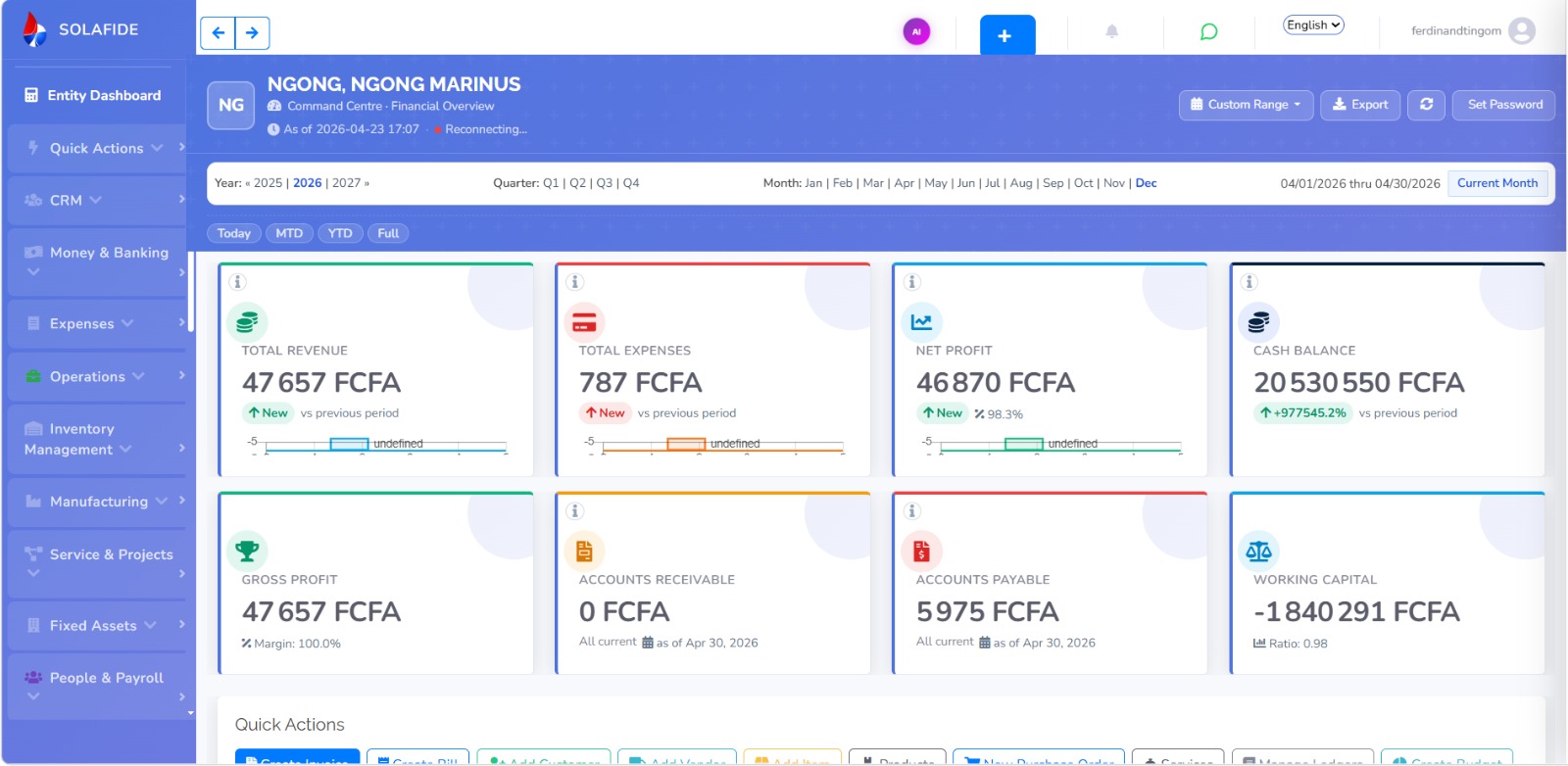
This is precisely the thinking behind Solafide Accounting Software. Solafide is designed with the realities of businesses operating within the OHADA environment in mind.
The objective is not simply to give businesses a place to enter transactions. It is to bring together accounting and business operations in a system that reflects the environment in which those businesses operate.
From sales and purchases to inventory, payroll, banking and financial reporting, the aim is to reduce the gap between what happens in the business and how that information is processed through the accounting system.
The Takeaway
OHADA accounting is not “different accounting” in the sense that fundamental principles change. Rather, OHADA provides a specific accounting and financial reporting framework that determines how accounting information is structured, recorded and reported.
Having accounting software is one thing. Having software that is appropriate for your accounting environment is another.
When your software records a 100,000 FCFA sale, does it merely record the amount—or does it understand where that transaction belongs within your accounting framework?
Follow Solafide for more practical articles on OHADA accounting, computerized accounting and accounting technology.
Note: The examples above are simplified educational illustrations. Actual accounting entries may vary depending on factors such as VAT, payment method, transaction type, applicable tax treatment and the specific circumstances of the entity.