Getting Started with OHADA Accounting: A Complete Guide for African Businesses
What is OHADA Accounting?
OHADA (Organisation pour l'Harmonisation en Afrique du Droit des Affaires) is a treaty signed by 17 African countries to harmonize business law across the continent. The OHADA Uniform Act on Accounting Law defines the SYSCOHADA Revised accounting system — the mandatory framework for all businesses operating in member states.
Whether you run a pharmacy in Côte d'Ivoire, a retail shop in Cameroon, or a consulting firm in Senegal, OHADA accounting rules apply to you. Understanding them is not optional — it is the foundation of doing business legally and efficiently in the OHADA zone.
The SYSCOHADA Chart of Accounts
The SYSCOHADA chart of accounts organizes all financial transactions into numbered classes:
- Class 1 — Permanent Capital: Long-term equity and debt financing
- Class 2 — Fixed Assets: Property, equipment, and intangibles
- Class 3 — Inventories: Stock, raw materials, and work in progress
- Class 4 — Third-party Accounts: Customers, suppliers, tax accounts
- Class 5 — Cash and Equivalents: Bank, cash, and mobile money accounts
- Class 6 — Expenses: All operating costs
- Class 7 — Revenue: All income and sales
- Class 8 — Special Accounts: Off-balance-sheet items
Key Financial Statements Required Under OHADA
Every OHADA-compliant business must produce three core financial statements at year end:
- Bilan (Balance Sheet): A snapshot of assets, liabilities, and equity
- Compte de Résultat (Income Statement): Revenue minus expenses = net profit or loss
- Tableau des Flux de Trésorerie (Cash Flow Statement): Operating, investing, and financing cash flows
How Solafide Makes OHADA Compliance Automatic
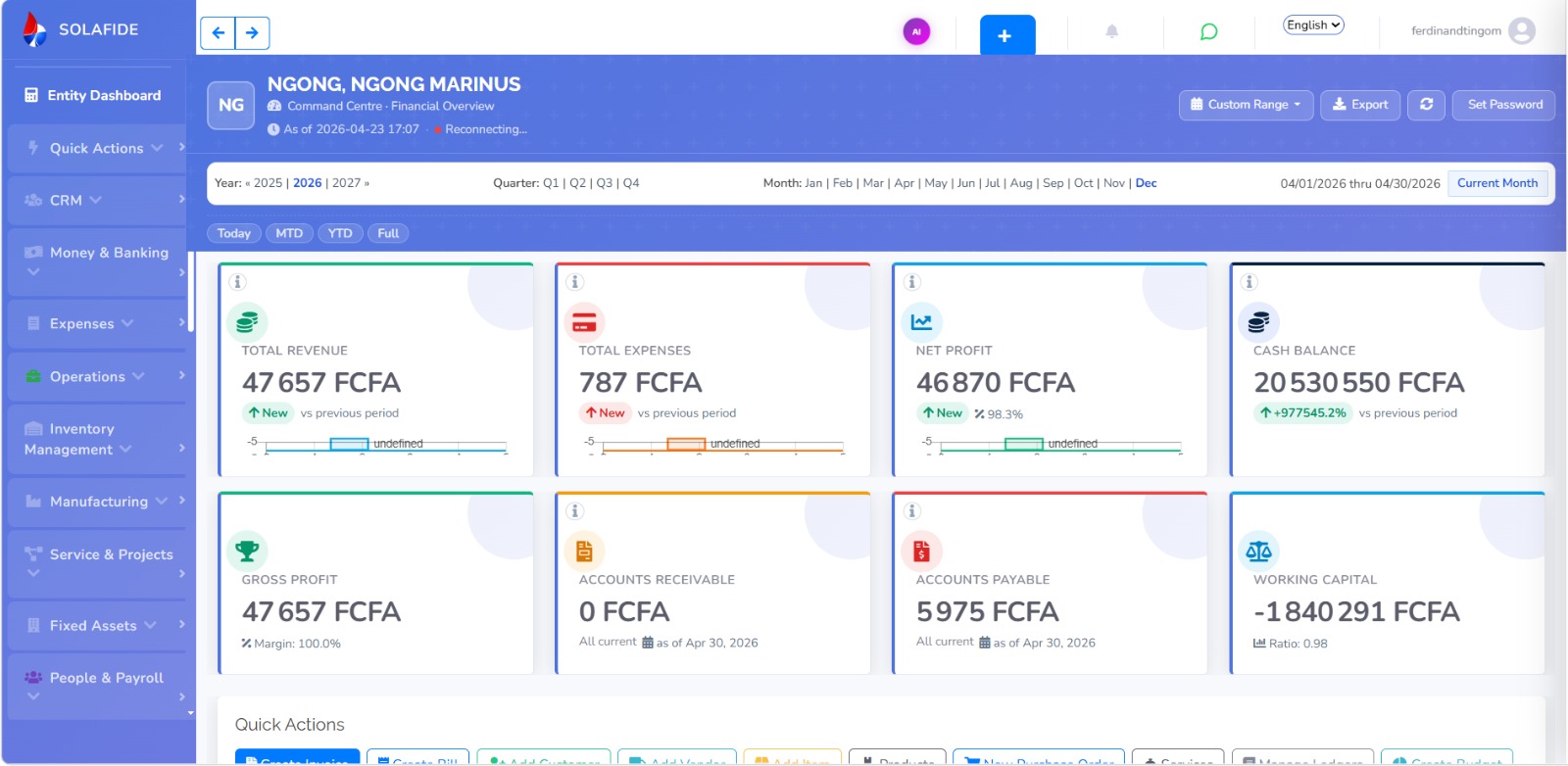
Solafide ERP is built from the ground up for SYSCOHADA. When you create an invoice or record a payment, the system automatically posts to the correct OHADA accounts. Your Balance Sheet and Income Statement are always OHADA-formatted and ready for your accountant or tax authority.
No manual configuration. No plugins. No workarounds. Just compliant accounting from your very first transaction.
Getting Started in 4 Steps
- Create your free Solafide account at app.solafideonline.com
- Set up your entity with your tax ID and fiscal year
- Import or build your Chart of Accounts using the OHADA template
- Create your first invoice — the system handles the rest
OHADA compliance does not have to be complicated. With the right tool, it can be automatic.